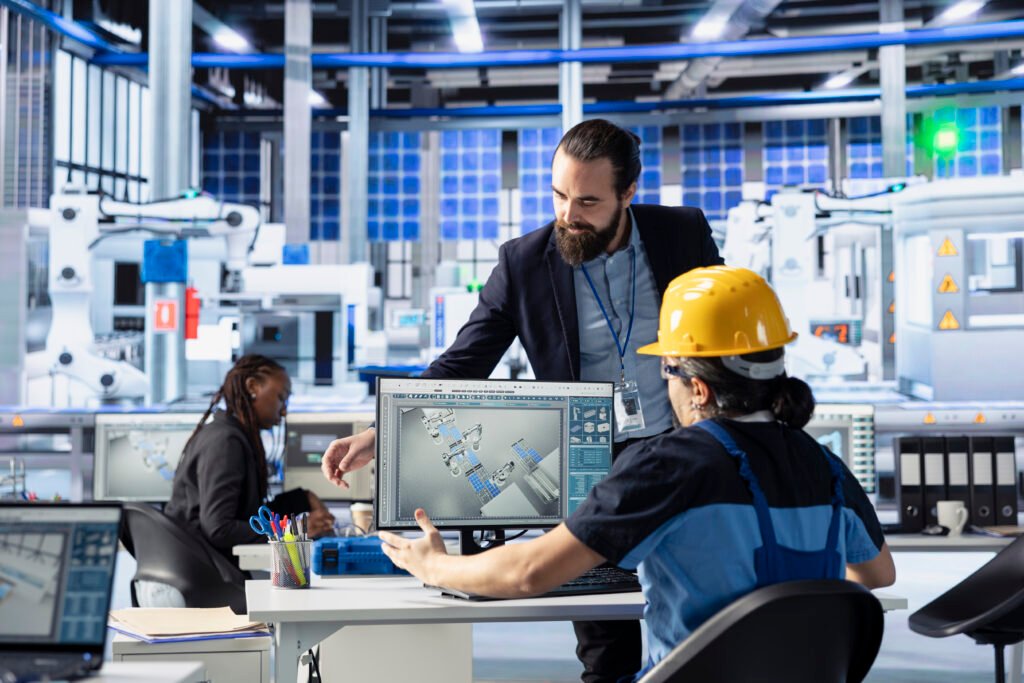

Industrial automation courses are becoming increasingly important as manufacturers are encountering labor shortages together with production demands that are more complicated. Robotriq offers practical, hands-on training that is meant for real factory environments. The courses include collaborative automated, end-of-arm tooling, machine tending, and system integration which equip the learners to apply automation technologies skill confidently.
Why Automation Skills Matter More Than Ever
Industrial automation has transformed and is no longer restricted to only large-scale factories that have dedicated engineering teams. The advent of collaborative robots, intelligent sensors, and modular automation tools has brought the cost of entry down for small and medium-sized manufacturers. Consequently, the job functions in production, maintenance, and engineering are changing up.
Now, the company would want the professionals in the manufacturing sector to be able to tell the types and working of the automated and robotic system, data transmission between machines, and safe human-robot interaction. This growing expectation has fueled demand for structured learning paths that translate technology into usable skills. One of the major reasons for the popularity of industrial automation courses across sectors is this demand.
What Are Industrial Automation Courses?
In essence, automation training programs aim to educate how machines, control systems, and software interact in an industrial set-up. Compared to traditional academic programs,many courses are delivered through practical application rather than theory alone.
Participants typically explore topics such as:
- Automation fundamentals and system architecture
- Basic programming logic for industrial equipment
- Human–machine interaction and safety concepts
- Introduction to robotics and automated workflows
Well-designed programs link these ideas directly to actual manufacturing situations, thus clarifying for the students not only the operation of automation but also the reasons for its particular implementation.
Industrial Automation Courses and Workforce Readiness
Bridging the Skills Gap
One of the main concerns that manufacturers have is the gap between the skills of the available workforce and the jobs that need to be filled. The machinery may be installed, but often the teammates do not have the trust or the know-how to operate it in a good way and this is where industrial automation courses play a practical role.
Rather than replacing workers, automation is redefining responsibilities. The operators will upgrade their positions to that of system supervisors. The technicians will change their roles to that of automation professionals. The engineers will spend more of their time on optimization and integration. Training provides the bridge between these roles, ensuring technology investments deliver real value.
Supporting Career Transitions
The education on automation mainly attracts the people from outside the manufacturing sector as well. Electricians, IT professionals, and mechanical service workers frequently consider formal training as a modern way to get into the industrial roles. The stimulating nature of hands-on troubleshooting makes it possible for the learning programs to absorb learners from a variety of backgrounds.
Skills Developed Through Modern Automation Training
Technical Foundations
A majority of programs kick off with the establishment of core concepts like sensors, actuators, controllers, and basic logic. Understanding how components communicate within a system is essential before moving to more advanced topics.
System Thinking
Beyond individual machines, learners are encouraged to think in terms of processes. What is the effect of automation on throughput? Where do the bottlenecks take place? This way of thinking becomes more and more significant as modern factories go towards being interconnected and relying on data for their operations.
Safety and Human Collaboration
The rise of collaborative robotics has made safety an important consideration rather than a secondary concern. The training nowadays comprises risk mitigation, safe interaction guidelines, and knowledge of standards—these are the abilities required in modern plants.
These skills are the reason why industrial automation courses tend to be regarded as practical investments rather than academic exercises.
Learning Formats Available in 2026
Automation training is no longer a problem restricted to classrooms. New flexible learning models have been created to accommodate working professionals’ needs.
- Online modules give basic knowledge and theoretical understanding
- Virtual labs duplicate actual equipment for practice without interruption
- On-site workshops provide direct interaction with industrial hardware
- Blended programs connect online learning with hands-on practice
Manufacturers are increasingly preferring training that simulates real deployment conditions, thereby, assuring that learning flows directly to the production floor.
Industrial Automation Courses in the Context of Collaborative Robotics
The transition to collaborative robots has resulted in a significant change in the training content of automation strategies. Modern curricula place the highest priority on the factors of usability, flexibility and compatibility with the current workflow.
Learners explore how robots can be deployed without extensive coding, how end-of-arm tooling affects application design, and how automation can scale incrementally. These topics not only connect to the current needs of the manufacturing sector but also indicate the wide practical experience provided by firms such as Robotriq, which are committed to offering user-friendly automation solutions.
Choosing the Right Automation Training Program
Not all courses deliver the same value. When evaluating options, manufacturers and individuals should consider several factors:
- Industry relevance: Are the current manufacturing challenges opposite in the course content?
- Practical application: Are real use cases and examples included?
- Instructor expertise: Is the training informed by real deployment experience?
- Scalability: Can the skills learned grow with future automation projects?
Programs that balance theory with application tend to deliver stronger long-term results.
The Business Value of Automation Education
ROI is the most common way organizations measure the impact of training. However, well-trained staff will most probably implement automation efficiently, prolong the operational time of the equipment, and modify the systems as per the conditions.
Rather than relying solely on external integrators, companies with internal expertise gain greater control over their automation roadmap. This is a significant reason why industrial automation courses are being included in workforce planning for the long term.
Industrial Automation Courses as a Long-Term Strategy
To some extent, automation is a one-time project only. It is a continuous process of improving, transforming, and learning. Training programs promote this kind of thinking by giving the teams versatile skills rather than limited tool-specific knowledge.
As technology constantly advances, so will the capability to learn and adapt, which will then be equally important as the technical skill. Structured education is the way organizations can develop that capability internally.
Looking Ahead: Automation and the Future Workforce
By 2026, automation is less about replacing labor and more about redefining how work is performed. The transformation of jobs into more analytical, collaborative, and technology-oriented ones is taking place alongside education that is the driving force in such a change.
Employees learn automation, which is a ticket to jobs that are stable and in demand. On the other hand, manufacturers are assured of gaining performance through technology investments. In both scenarios, industrial automation courses are the means through which change is successfully managed.
Get Started with Automation Training
Learn how people and machines can work together to improve manufacturing. Robotriq’s industrial automation courses offer hands-on training with real robots and practical factory skills.
Contact us today or enroll in a course to give your team the experience they need to succeed.