CERTIFIED PROCESS AUTOMATION PROFESSIONAL (CPAP)
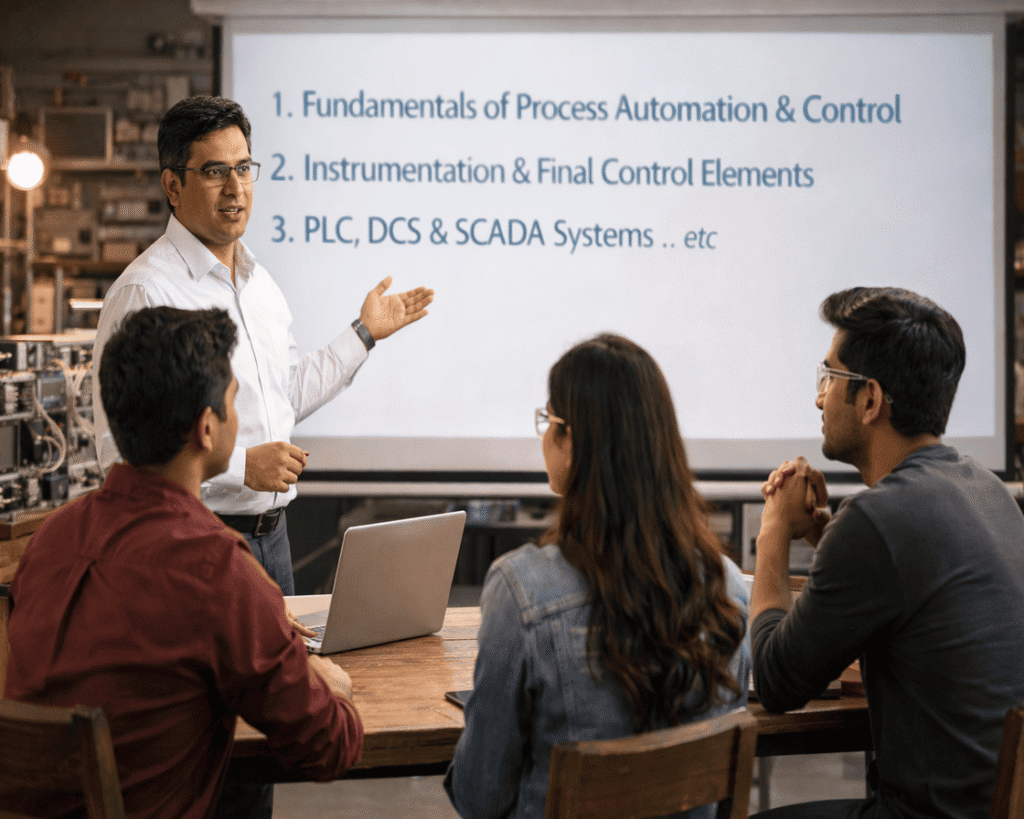
CERTIFIED PROCESS AUTOMATION PROFESSIONAL (CPAP) – Professional Level
DURATION : 1–2 MONTHS
- Introduction to industrial automation
- Role of automation in process industries
- Automation hierarchy (Field, Control, Supervisory, Enterprise)
- Continuous, batch, and discrete processes
- ISA symbols and basic terminology
- Overview of automation system architectures
- Open-loop & closed-loop systems
- Feedback and feedforward control
- Control system components
- Process dynamics and modeling basics
- Stability and system response
- PID control concepts and applications
- Measurement principles and accuracy
- Temperature, pressure, flow, and level instruments
- Analytical instruments (pH, conductivity, gas)
- Signal standards (4–20 mA, HART, fieldbus)
- Calibration and testing practices
- Instrument selection using datasheets
Control valves and actuators
Valve characteristics and sizing basics
Electric motors and motor control
Variable Frequency Drives (VFD)
On-off control vs modulating control
PLC architecture and operation
DCS system overview
PLC vs DCS comparison
SCADA systems and applications
HMI design basics
Digital, analog, and remote I/O systems
IEC 61131-3 programming standards
Ladder logic, function block, structured text
Control logic development
Interlocks and alarm handling
Simulation and testing
Commissioning practices
Industrial communication protocols
– Modbus
– Profibus
– Profinet
– Ethernet/IPNetwork topologies
System integration challenges
MES and ERP interface basics
Data acquisition and historians
Control panel components
Power distribution and grounding
Wiring practices and standards
Electrical drawings and documentatio
Compliance with IEC, IEEE, & NEC standards
Syllabus

Job Opportunity
Faq
The course covers two PLC brands (choose from Schneider, Siemens, Allen-Bradley, or Delta), plus one SCADA system, one HMI, and two VFDs.
The course is 1–2 Weeks, depending on the fixed schedule.
Yes, the training follows NFPA 70E and OSHA-aligned electrical safety practices.
The course provides practical learning through real-world examples and hazard analysis and safety implementation methods.
Yes, the course covers learning about hazards associated with arc flashes, and how the same can be mitigated by selecting and then wearing proper PPE.
Yes, Indian regulations, inspections, and compliance requirements are included.
Yes, the course is designed to support professionals managing live electrical systems.
Yes, participants receive CESW certification after meeting eligibility and passing the exam.
Yes, the course is heavy on injury prevention, risk management, and safety program execution.
Yes, maintaining CESW certification requires ongoing professional development.
Our Brands