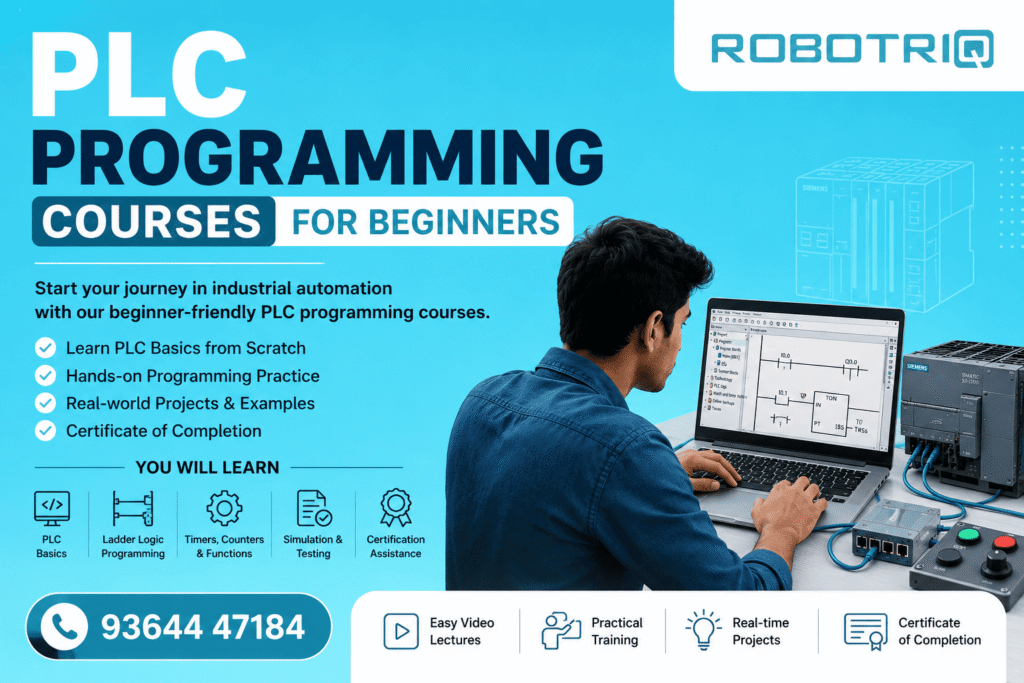
Industries are moving toward automation, and so PLC skills are getting extremely in demand. Structured plc programming courses for beginners, help new learners understand the basics more easily, through practical training in the background.
Robotriq provides PLC training for beginners level students with hands-on practice instead of only theory.This helps learners build practical skills and prepare for automation careers.
What Is PLC Programming?
A Programmable Logic Controller (PLC) is essentially an industrial computer used to automate machines and, well, processes. PLCs run the show for motors, conveyor systems, sensors, pumps, robotic systems and production lines, in factories.
PLC programming is mainly about logic that tells machines how to operate automatically based on inputs and conditions.
For example:
- Starting a motor when a button is pressed
- Stopping machinery during emergencies
- Controlling water levels in tanks
- Automating conveyor belts
- Managing industrial temperature systems
What You Learn in PLC Programming Courses for Beginners
A well-structured PLC course helps learners understand both theory and practical applications used in industries.
PLC Hardware Fundamentals
Students learn about PLC components such as CPU, input modules, output modules, and communication systems.
Ladder Logic Programming
This section teaches how to create logical instructions used to control industrial machines.
Sensors and Actuators Integration
Learners get how a PLC comes together with real equipment, like sensors , motors and those basic switches too.
Timers and Counters Operations
This module explains how machines operate based on time delays and counting functions.
Real-Time Industrial Projects
Hands-on practice helps students apply plc programming courses for beginners concepts in real automation scenarios.
What Companies Expect from PLC Programming Beginners
After completing plc programming courses for beginners, companies expect candidates to be job-ready with practical knowledge.
Strong PLC Logic Understanding
Candidates should strong in understanding and able to read, design, and troubleshoot basic PLC programs.
Practical Machine Control Knowledge
Understanding and learn how industrial machines operate using automation systems is essential.
Hands-On Project Experience
Hiring people prefer candidates who have worked on real or simulated automation projects.
Problem-Solving Skills
Automation professional must quickly identify and fix system issues in the industries.
Adaptability to Industrial Tools
Candidates should be flexible in learning different PLC software and systems.
Benefits of PLC Programming Courses for Beginners
A structured plc programming courses for beginners program provides strong career advantages for students and engineers.
High Demand in Industry
PLC professionals are required in almost every manufacturing sector.
Better Job Opportunities
Automation roles often offer higher career growth compared to general technical jobs.
Practical Industrial Exposure
Training focuses on real-world machine control systems.
Strong Career Growth Path
PLC skills lead to advanced automation and engineering roles.
Future-Ready Skill Development
PLC programming is a core part of modern Industry 4.0 systems.
Career Opportunities After PLC Programming Courses for Beginners
Completing plc programming courses for beginners opens multiple career paths in industrial automation.
PLC Programmer
Develops and maintains industrial machine control logic.
Automation Technician
Handles installation and maintenance of automation systems.
Maintenance Engineer
Ensures machines run effectively with minimal downtime in the Industrial or factories.
Control Panel Engineer
Works on designing and managing industrial electrical panels.
Industrial Support Engineer
Provides technical support for automation systems in factories or industrial.
Why Choose Robotriq for PLC Programming Courses for Beginners
Robotriq offers industry-focused training designed to build real industrial skills.
Industry Based Curriculum
The learning path is mapped to what the automation industry needs right now, and it follows the current state of things, pretty closely.
Hands On Training
Students end up practicing PLC programming using hands on exercises, taken from real world scenarios.
Expert Trainers
The sessions are taught by automation professionals with experience, who have been in the field.
Live Project Experience
Learners work with real time industrial simulation projects, so it feels more grounded.
Career Support
Career support and guidance is provided as well, to help students locate job opportunities and keep moving forward.
How Long Does It Take to Complete PLC Programming in Robotriq?
The learning duration depends on your goals and background in the PLC courses.
Typical Learning Timeline
| Learning Level | Estimated Time |
| Basic PLC Concepts | 2–4 weeks |
| Ladder Logic Programming | 1–2 months |
| PLC + SCADA Integration | 2–3 months |
| Industrial Project Experience | 3–6 months |
How to Choose the Right PLC Programming Course for Beginners in Today’s Generation
Selecting the right course is important for building a strong automation career.
Updated Course Content
The syllabus should include modern PLC concepts and applications.
Practical Learning Focus
Hands-on training is essential for industrial understanding.
Experienced Trainers
Industry experts provide better real-world insights.
Project-Based Learning
Real projects improve technical confidence.
Placement Support
Good institutes provide career guidance and job assistance.
Start Your Automation Journey with Robotriq
A good foundation in plc programming courses for beginners helps learners build successful careers in industrial automation, like really get moving.
👉 Join Robotriq today to start practical training, gain real industrial experience, and develop job-ready PLC skills.