EXPERT-LEVEL TROUBLESHOOTING & MAINTENANCE
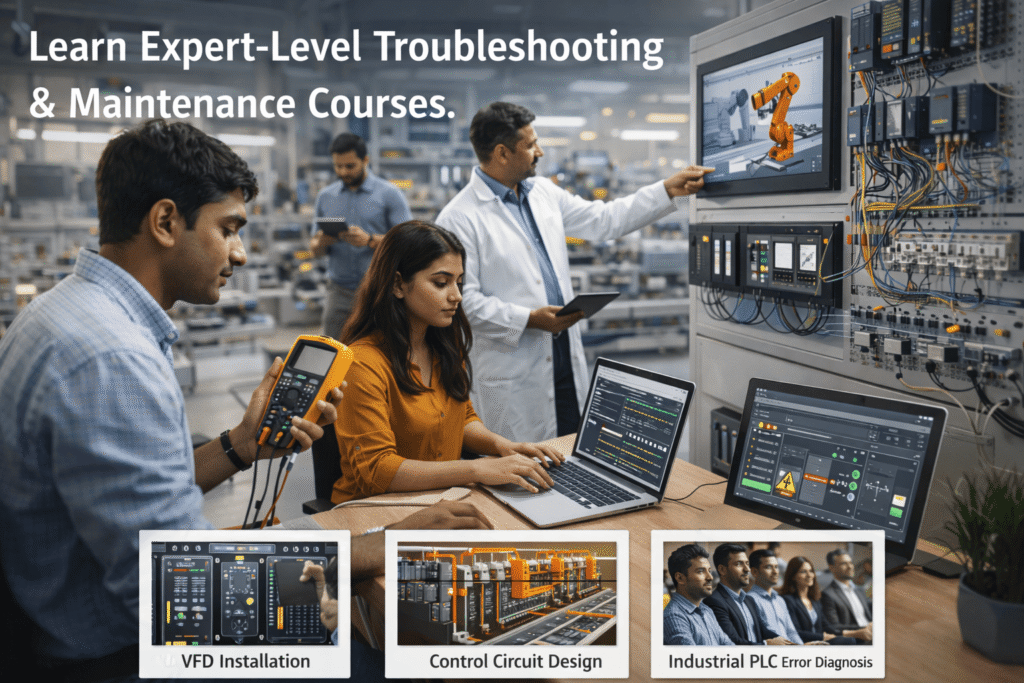
EXPERT-LEVEL TROUBLESHOOTING & MAINTENANCE COURSES (ETMC)
DURATION : 1 MONTHS (60Hrs.)
- Introduction to servo motors and drives
- Importance of servo systems in automation
- Working Principle of Servo Motors
- Understanding servo motor construction and operation
- Principles of feedback control in servo system
- Types of Servo Motors
- Different types of servo motors: AC servo, DC servo, and stepper motors
- Selection criteria based on application requirements
- Servo Drives and Controllers
- Functions and features of servo drives
- Programming servo controllers for motion control tasks
- Servo System Setup and Configuration
- Installation and wiring of servo motors and drives
- Parameter configuration for optimal performance
- Motion Control Programming
- Programming motion profiles for servo motors
- Trajectory planning and motion synchronization
- Applications of Servo Systems
- Industrial applications of servo systems in robotics, CNC machining, and packaging
- Case studies and examples of servo-controlled systems
- Internet of Things (IoT) in Industrial Automation
- Introduction to IoT
- Definition and concept of IoT
- Evolution and significance of IoT in industrial automation
- Components of IoT Ecosystem
- Communication protocols (e.g., MQTT, CoAP)
- Edge devices and gateways
- IoT Architecture
- Layers of IoT architecture (Perception, Network, Middleware, Application)
- Role of cloud computing in IoT
- Integration of PLCs with IoT
- Interfacing PLCs with IoT devices
- Data acquisition and transmission from PLCs to IoT platforms
- IoT Platforms and Solutions
- Overview of IoT platforms (e.g., AWS IoT, Azure IoT, Google Cloud IoT)
- Application development and deployment for industrial IoT
- Data Analytics and Machine Learning in IoT
- Data preprocessing and analysis techniques
- Predictive maintenance and anomaly detection using machine learning algorithms
- IoT Security and Privacy
- Security challenges in IoT deployments
- Best practices for securing IoT systems and data
- Industrial IoT Applications and Case Studies
- Smart manufacturing
- Predictive maintenance
- Asset tracking and monitoring
- Energy management.
- Preventive Maintenance
- Productive Devices
- Maintenance Schedule preparation
- Electrical Control Circuit Development
- Electrical Drawing Analysis
- VFD Drive Installation & Parameters in Motors \
- VFD Error Codes & Corrective Actions
- Current Control in Motors
- Energy Monitoring System using SCADA
- Troubleshooting PLC Corrective Actions
- PLC Error Codes
- Troubleshooting SERVO Motors & Drives
- SERVO DRIVE Parameter settings
- Servo Error Codes Corrective Actions
- Instruments Controls Wiring & Maintenance (Sensors, Controllers, Process Indicators)
- Earthing
- Review
- Introduction to switch gears & accessories
- Basics of control & power drawings
- General protection involved in panel
- Load management (connected load, running load, load factor)
- Indications (Ammeter, Volt Meter, PF & KW Meter etc.)
- Preparation of general arrangement diagrams, busbar sizing
- Electrical protection
- Preparation of power & control circuits
- General wiring guidelines / practices
- Maintenance & troubleshooting of control circuits in live panels
- Designing Power & Control Drawings through AutoCad
- Review.
Syllabus

Job Opportunity
Faq
The course covers advanced industrial automation training including 3 PLC brands (choose from Schneider, Siemens, Allen-Bradley, or Delta), SCADA (1 system), HMI (2 systems), and VFD (2 drives).
The course is designed for engineering graduates (or those with equivalent background) seeking in-depth technical training to become industry-ready automation engineers.
The duration is 2 months (approximately 160 hours).
The course includes:
Fundamentals of Electrical Engineering (basic electricity, circuits, motor starters, relay logic, contactors, safety, etc.)
You will learn PLC programming/configuration (two brands), SCADA, HMI panel design/operation, VFD (Variable Frequency Drive) wiring and control — giving a broad exposure to core industrial automation technologies.
Not necessarily — while prior knowledge may help, the course is designed to enable people to learn from the fundamentals to industry-ready level.
Since it covers multiple PLC brands and includes SCADA, HMI, and VFD — and offers a full 120-hour program — it’s more comprehensive than basic/introductory courses. This increases your readiness for real industry work.
Yes — as the name suggests, you become a “Certified Automation Engineer” after successful completion of the course from Robotriq.
Yes — the course emphasizes practical, industrial-type lab environment work including wiring, integration of PLC with sensors/actuators, SCADA/HMI setup, motor/VFD control — similar to real factory environment.
Engineering graduates (especially electrical, electronics, instrumentation, mechanical), diploma holders, technicians, or anyone looking to start or upgrade a career in industrial automation would benefit.
Our Brands