DIPLOMA IN INDUSTRIAL AUTOMATION
DIPLOMA IN INDUSTRIAL AUTOMATION
DURATION : 30 DAYS (60 Hrs.)
Syllabus
- Introduction to Electrical Engineering
- Applications used in industries
- Basic Concepts of Electricity
- Ohm’s Law
- Electrical Components and Symbols
- Electrical Circuit Analysis
- Relay logics and circuits
- Series and Parallel Circuits
- Voltage, Current, and Resistance
- Power and Energy in Electrical Systems
- Electrical machines(Motors and Types)
- Electrical Safety Practices.
- Importance of Relay
- Relay
- Latching/ Holding/ Retaining
- Relay wiring with Logic gates
- Limit switch
- Reed switch
- Solenoid
- Actuators
- Overview
- Introduction to PLC
- Advantages of PLC Control Panel
- Architecture of PLC
- Working principle of PLC.
- PLC type and selection details
- Hardware configuration
- Software Explanation
- Communication details
- Online & Diagnostics
- Memory management
- Different types of Inputs and Outputs
- Concept of Digital I/O
- Concept of Analog I/O
- Concept of PLC scan cycle
- Maintenance and troubleshooting of PLC
- Selection of PLC
- Wiring of PLC
- Source type input wiring
- Sink type input wiring
- Transistor type output wiring
- Relay type output wiring
- Various transmitters / sensors used in industrial applications
- Position sensor: Photo electric, proximity sensor, encoder)
- working principle, types selection guidelines
- Flow measurement, working principle, types, selection guidelines
- Pressure measurement, working principle, types, selection guidelines
- Load measurement, load cells
- Level measurement, working principle, types, selection guidelines
- Solenoid valves, control valves, smart transmitters
- Instrument transformers (CT,VT)
- Process control basics, closed & open loop control
- Process controllers (on-off, proportional, PID.
- Programming Language – Ladder diagram
- Device configuration – Start / Stop CPU
- Addressing details Digital, I/O’s
- Addressing details Analog, I/O’s
- Data Types – Bool, Integer, Real, Word, Dword
- Compile –Download, Upload program.
- Bit logic – NO, NC, NOT, SET, RESET, POSITIVE & NEGATIVE EDGE
- Timer – ON Delay, OFF Delay, Retentive Timer, Pulse Timer
- Counter – UP Counter, Down Counter, UPDOWN Counter
- Comparator – >, <, =
- Move Function
- Data type Conversion – ROUND, TRUNC, CEIL, FLOOR
- Math Functions – ADD, SUB, MUL, DIV, MOD, ABS, NEG
- Program control – CJ, CALL, LABEL, RETURN, MC, MCR.
- Data type Conversion – ROUND, TRUNC, CEIL, FLOOR
- Math Functions – ADD, SUB, MUL, DIV, MOD, ABS, NEG
- Program control – CJ, CALL, LABEL, RETURN, MC, MCR.
- Programming Language – Ladder diagram, FBD, STL
- Function Block, Functions – OB, FB, FC, DB
- Table, Cross reference
- Analog Configuration
- Analog signals 0v to 10v DC, 4mA to 20mA DC
- Adjusting gain & offset in A/D conversion
- Adjusting gain & offset in D/A conversion
- Scale function
- PID Configuration
- Real Time Clock – RTC
- High Speed Counter – HSC
- Pulse Train Output – PTO
- Libraries
- PDF conversion
- Real Time Applications
- Understanding the basic techniques of controlling an AC motor.
- Block Diagram of VFD
- How an AC drive is constructed, and how the various protection features work
- Operation of the AC drive.
- AC drive range and specification.
- Motor Nameplate – Drive
- Modes of Control
- V/F Control
- Speed & Torque
- Vector control
- Auto Tuning / ID Run
- Frequency Reference Setting
- Acceleration and De-Acceleration Control
- Forward and Reverse control
- Monitor / Display parameter
- Parameter Selection
- Parameter programming
- Set points
- Multi-speed control
- External speed control by Analog Input / Analog output
- Remote control
- Jogging concept
- Dynamic Braking
- Master slave concept
- Braking resistor
- Communication with PLC
- Getting started with HMI
- Creating applications, creating tags
- Downloading /uploading programs
- Creating alarm messages
- Communication with PLC
- Fault diagnostics
- New Window Creation & Linking.
- Button Creation and design.
- Output Design.
- Numeric Scaling and Demonstration.
- Multi-State Word Lamps and Switches.
- Alarm creation.
- Log Creation and Monitoring.
- Admin and User Role Creation and Security Assigned
- Trend Graph.
- Controlling field Devices.
- Tricks & Tips.
- Introduction to HMI / SCADA
- Software Explanation
- Download and uploading the programs
- IP address configuration
- Making New Project
- Features of SCADA.
- Difference Between SCADA and HMI
- Difference Between SCADA and PLC
- Making and Editing New Graphic Display
- Scada Tags – Memory, I/O, Discrete, Real, Integer, message
- Runtime, Development
- Animation
- Movement, Filling, Visibility, Blinking, Orientation, Height width,
- Tag creation
- Trend Details
- Real-time trend
- Historical trend
- Function Keys
- DDE / Suite link protocols
- Alarms and Events Details
- Security Control.
- Activity Recap
- Role plays and Feedback
- Trainer Insights
- Closing Remark.

Job Opportunity
Students after completing the Beginner Diploma in Industrial Automation course learn the basics of industrial automation. They get familiar with PLC, SCADA, and simple machine control used in factories. The training helps them understand real work situations. Beginners can apply for trainee or maintenance-related jobs. Many industries prefer candidates with automation knowledge. This course helps students take the first step into the industrial field.
Faq
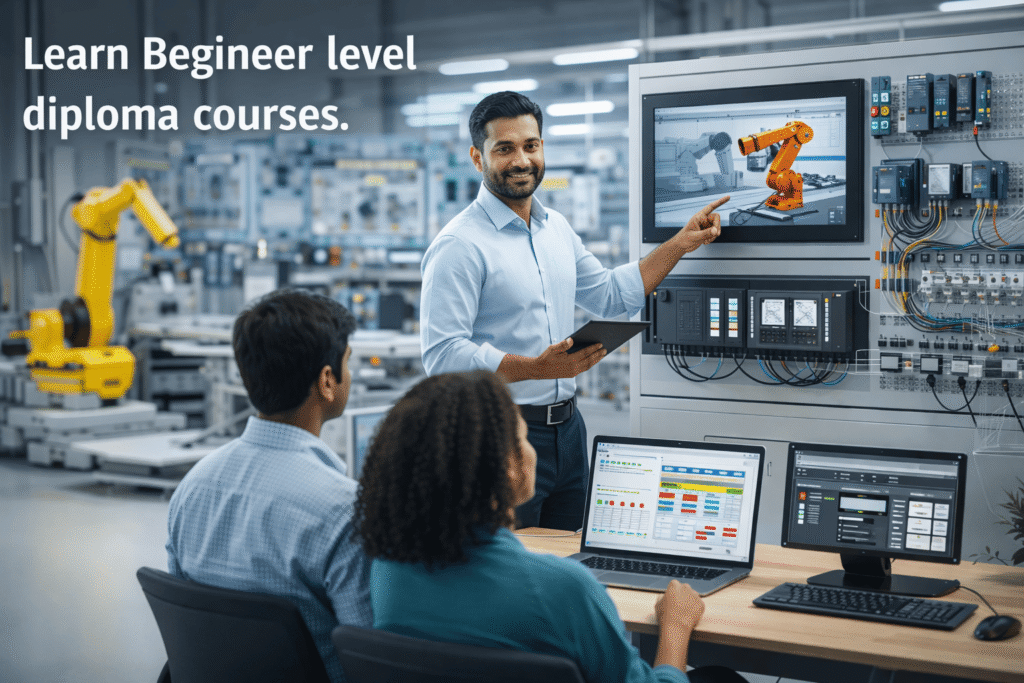
The course includes hands-on training covering one PLC (from brands like Siemens, Schneider, Mitsubishi, ABB or Delta), one SCADA, one HMI, and one VFD.
It’s designed for beginners — students, fresh graduates, technicians or anyone interested in starting a career in industrial automation.
The course duration is 30 days.
The course emphasizes practical, hands-on training with real equipment (PLC, SCADA, HMI, VFD), making it strongly practical.
No — since it’s a beginner-level diploma, prior experience isn’t mandatory. The course is intended to build foundational skills.
You will receive a diploma (or certificate) from Robotriq in Industrial Automation upon successful completion.
You’ll work with PLCs (from brands like Schneider, Siemens, Mitsubishi, ABB or Delta), SCADA, HMIs, and VFD (Variable Frequency Drive).
You’ll work with PLCs (from brands like Schneider, Siemens, Mitsubishi, ABB or Delta), SCADA, HMIs, and VFD (Variable Frequency Drive).
The course is suitable for beginners of all levels — including engineering students or graduates, technicians, or automation enthusiasts.
Because this is a hands-on, lab-based course working with actual industrial automation hardware and software, you gain practical experience — a critical advantage over purely theoretical or online-only study.
Our Brands